
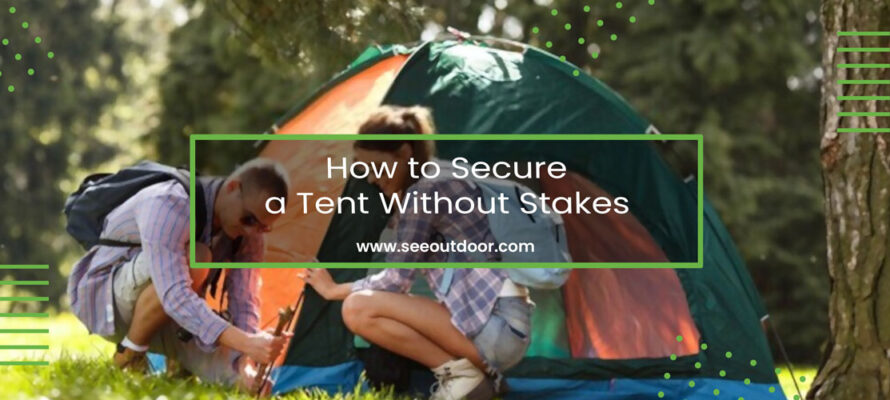
Planning your next camping adventure? Undoubtedly it is a great way to escape the hustle and bustle of daily life and spend some time in nature.
While staking your tent is the traditional method for securing it, sometimes you may find yourself in a situation where stakes are not available or not an option. So, what can you do if you need to secure your tent without stakes?
Fortunately, there are several alternative methods for keeping your tent stable and secure, even on hard ground. In the following article, we will explore the 8 most simple and effective ways how to secure a tent without stakes.
Keep reading…
How to Secure a Tent without Stakes?
Here is a list of the top 8 most easy and effective methods to keep your tent stable and upright:
1. Using Heavy Objects
This method is by far the easiest and most common method for securing a tent without stakes.
All you need to do is find some heavy objects like rocks or logs in the area and place them at the corners of your tent. Then, use the tent's guy lines to tie the tent down to the objects.
This method is particularly effective on soft ground. Hence, make sure that the objects you use are heavy enough and won't move during strong winds.
N.B: If you are camping in an area where rocks or logs are scarce, you can always bring a couple of heavy bags filled with sand or dirt to use as anchors.
2. Using Guylines and Tensioners
The second one on the list is certainly guylines. They are ropes or cords that attach to the tent's corners and extend out to anchor points. They are a camper's best friend when securing a tent without stakes.
On the other hand, tensioners are those devices that can be used to adjust the tension on the guylines, which helps to keep the tent stable and upright, especially in windy conditions.
It's a great way to give your tent extra stability when stakes aren't an option.
3. Using Sandbags or Water-filled Containers
If you're camping on soft ground, sandbags or water-filled containers are one of the most effective ways to secure your tent. They are great for adding weight and stability to the corners of the tent, while water-filled containers can be used as anchors for guylines.
Simply fill the bags or containers with sand or water and place them at the corners of your tent. Then, use the tent's guy lines to tie the tent down to the containers.
They will weigh down the tent and keep it in place. Plus, they are lightweight, super easy to transport, and take up minimal space in your camping gear, making them a great option for camping or backpacking trips.
Hence, it goes without saying that if you are camping on soft ground or looking for a more portable option than rocks or logs, nothing can be better than using sandbags or water-filled containers.
4. Using Natural Anchors
If you are camping in an area with natural anchors like trees or rocks, know that you are in absolute luck. You can conveniently use these to secure your tent without the need for stakes. Besides, it is extremely fast and easy to do.
Just tie your tent's guy lines to these anchors, and you will be all good to go. Tie up properly, as it will keep the tent firm and stable in extreme weather conditions.
And not to mention, they are one of the most incredible ways to blend in with the surroundings and to keep the tent fully protected.
5. Using a Tarp
Next up on the list, we have a tarp. If you are camping in an area with trees, you can use a tarp to secure your tent.
A tarp can be placed under the tent and tied down with the tent's guy lines. Or, you can simply tie the tarp to the trees and place your tent underneath. The tarp will provide an extra layer of protection against the ground and a barrier against the ground, protecting your tent from rain and other windy conditions.
6. Using Sticks
If you're camping in a forested area or on soft ground or where sticks (must be long enough) are plentiful, you can ideally use these sticks to secure your tent.
Simply push the sticks into the ground at the corners of your tent. After then, use the tent's guy lines to tie it down to the sticks. It's both a simple and easy solution for an entire stake-less setup.
7. Tie to Tree
Tying the tent lines to a tree is one of the most simple and effective methods of securing a tent if the trees are large and sturdy enough to withstand the wind. This method is ideal if you are camping in a location with plenty of trees.
Simply tie your tent's guy lines to nearby trees to keep it in place, and you will be all set to blend in with the surroundings while securing your tent.
8. Using a Combination of Methods
Camping in an area with varying terrain? Or are you confused about which method to go for? Well, in any such case, you can always use a combination of methods.
For example, you can use heavy objects like rocks or logs at the corners of your tent and then use guylines and tensioners to provide extra stability.
Or, you could use sandbags at the corners of your tent and use guylines to tie them down to nearby trees. No matter which one you select, remember it's always a good idea to have a backup plan in case one method isn't enough.
Concluding Words
Whether you are camping for the first time or you are an experienced camper, it's essential to know how to secure a tent without stakes is always an essential skill. Find the best option for your next camping trip, from heavy objects like rocks and logs to guylines and tensioners.
With these methods mentioned above, you can rest assured that your tent will stay put, even in harsh weather conditions. So pack your bags, grab your tent, and get ready to take off on your next camping adventure!
FAQs
Have a look at the most commonly asked questions in case you have anything to clarify regarding the topic:
How Do You Secure a Tent on Hard Ground?
To secure a tent on hard ground, use heavy objects like rocks or logs as anchors, tie guylines to nearby trees or natural anchors, or use sandbags or water-filled containers. It's also helpful to use a combination of methods to ensure maximum stability.
Do You Need to Stake Your Tent?
Of course. Staking a tent is a must to ensure its stability, keeping the tent anchored to the ground and preventing it from collapsing or shifting. However, staking may not be necessary for certain conditions, such as camping on soft soil or sand, or if you have alternative methods to secure the tent without stakes. In those cases, you can use heavy objects, guylines, sandbags, or natural anchors to stabilize the tent.
How Can I Make My Tent More Secure?
To make your tent secure, anchor it firmly to the ground. To increase the stability of your tent, consider using heavy objects, tying guylines to nearby trees or natural anchors, using sandbags, etc. Additionally, make sure to pitch your tent in a sheltered location from the wind, and consider using a tarp for extra protection.
How Do You Keep A Tent From Blowing Away?
You can prevent your tent from blowing by using heavy objects as anchors, such as rocks or logs, tying guylines to nearby trees or natural anchors, or using sandbags or water-filled containers. Besides, combining these methods can help ensure that your tent stays put and doesn't blow away during windy conditions.
 What Do Scope Numbers Mean?
 What Does 3x9x40 Mean on a Rifle Scope
 Explained: What Does 3 Season Tent Mean for Camping?
 What is a Rainfly on a Tent: Is It Essential for Camping?
 What is the Objective Lens on a Rifle Scope