
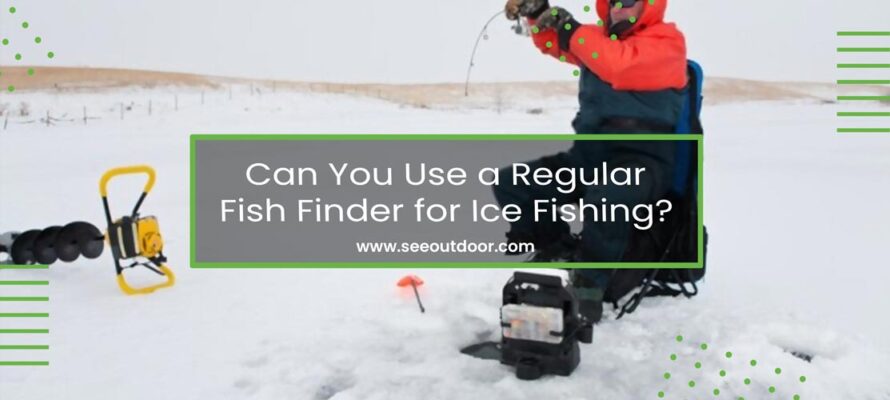
Ice fishing and regular water fishing appear to be different. However, any traditional fish finder is usable for ice fishing, just like water fishing.
Let’s know can you use a regular fish finder for ice fishing and how to do that.
What Will Happen If I Use a Regular Fish Finder for Ice Fishing?
You can still get a good result If you use a regular fish finder on ice fishing. But practically, the result may vary.
On a clear ice surface, a regular fish finder helps to capture lots of fish. Generally, a smoother ice surface allows more airflow. Hence, a SONAR works better on a smoother ice surface.
Therefore, no major problem will arise due to regular fish finders on ice fishing. You will probably get the expected amount of fish with a traditional fishfinder.
How Do You Use a Regular Fish Finder for Ice Fishing?
You might need years of experience to get the expected levels of fish from an icy surface. Any regular fish finder can do the job for you. However, you have to be cautious about the fish finder and the transducer.
Here are the steps you can start ice fishing:
- Find a location in a lake or source of water with a parallel ice surface.
- After finding the exact location, take all the necessary equipment.
- Create 4/5 holes in the place where you may approach fishing.
- Sit around the hole and enter the fish finder. Don’t forget to check the transducer reading.
- Ensure the connection between ice and transducer. Otherwise, the locater machine will not deliver signals properly.
- When everything is perfectly set, you will see signals of fish detection.
- Start fishing till the last fish remains in the hole.
- After finishing on a certain hole, move forward to the next one.
Precaution:
Well, don’t forget to keep the locater safe from ice. Otherwise, the machine will be fizz and will not work properly.
Moreover, the indicator may not work properly on rough ice, uneven surfaces, or even an old iceberg. If you found this issue, remove the fish finder and look to get the fish from other holes.
Pro tip: To shoot SONAR through the ice, most importantly, you’ll need an accurate locater, plus a versatile power source.
Can Ice and Cold Damage the Fish Finder?
Yes, there is a high risk of damaging the regular fish finder by ice. Icefish finders come with protection cover to stay safe from ice.
On the other hand, general fish finders don’t have any protective shield. For that reason, the chances of damaging the fish finder by ice and cold are very high.
Moreover, the transducer is an electronic machine. So extreme cold and ice can be harmful to electronic materials. Besides, as the transducer needs to attach to the ice with fishing, you need to be very careful about the indicator. Always try to cover up the machine and keep a distance from ice.
Use a cover on the screen for protection. Moreover, you can keep the wire lines and the locater covered by a towel.
Conclusion
Ice fishing seems very unfamiliar with regular water fishing. Interestingly, if you don’t have an ice fishing kit, you can use regular fish finders. However, you have to do that carefully, as regular fish finders have less protection from ice and a low-temperature environment.
FAQs
The following section contains a list of frequently asked questions and answers on this topic.
Is a fish finder worth it for ice fishing?
If you want to catch fish on ice, any regular fish finder is enough. Somehow, if you manage a good quality sonar device, you will be able to double the number of catching fish compared to regular fishing.
Can you use a standard transducer for ice fishing?
Yes, you can do ice fishing with a regular standard transducer—you need a portable power supply to operate the machine on ice. Any portable transducer works very well for ice fishing.
Do you need sonar for ice fishing?
There are lots of advantages of using a sonar unit on ice fishing. You can determine the depth of ice, size of the holes, water flows, and many more. A sonar unit can help you with winter fishing.
 How to Read a Fish Finder Screen: Complete Guide
 How does a Fish Finder Work
 Best Fish Finder Under $300 [Ultimate Buyer’s Guide & Review]