
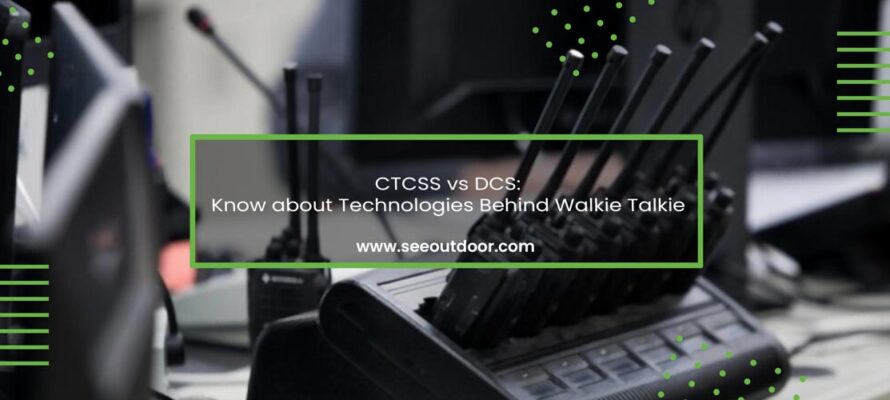
The Continuous Tone Coded Squelch System (also known as CTCSS) makes use of continuous tones with a frequency below 300 Hz. On the other hand, the Digital-Coded System (also known as DCS) makes use of digital data or encoded words that are very distinctive and can all be used on the same channel without causing interference.
Before social media platforms, people used walkie-talkies to talk to each other over long distances. For business, many people still prefer professional walkie-talkies. CTCSS and DCS are two of the most common technologies used to make high-quality walkie-talkies.
This article tells you everything you need to know about the technologies behind the best walkie-talkies: CTCSS vs. DCS. Let’s dive in.
What is CTCSS?
CTCSS stands for Continuous Tone Coded Squelch System. It is an analog tonal code of a radio communication system. When you share a two-way radio communication system, CTCSS tone decreases the listening disturbance of the user on the other side. This system affixes the tone at a certain transmission point in your radiofrequency.

When there are more users instead of merely one group, CTCSS technology makes the other users, especially those connected without CTCSS tone or with a different CTCSS tone. It mutes the users until they carry a subaudible radio tone.
One notable thing is that these tones produced by CTCSS mode are not generally audible to human ears. The communication grade speakers make these tones processed before sending them to headphones and the general speakers. Electronic Industries Alliance (EIA) makes these CTCSS tones standardized.
What Does DCS Mean on a Walkie Talkie?
Walkie-talkie DCS or Digitally Coded Squelch is a digital signal spectrum that holds much more bandwidth. It is the developed version of CTCSS.
In a DCS system, if you are using a comprehensive signal that contains several various components of frequency in a mode of low frequency, the receiver or transmitter cannot be able to distort those signals completely. They can just reduce or degrade the signal.
To get the highest output from the DCS system, the transmitter and the receiver must hold the same frequency. If there is an error in the receiver or the transmitter, getting a discriminator output might not function well. It might make the decoder blocked as well.
A sub-audible filter is necessary for the DCS system’s dependable operations because it takes the energy of low frequency away before the audio gets re-transmitted.
Difference between CTCSS and DCS
- The main difference between CTCSS and DCS is that CTCSS employs continuous or uninterrupted tones, which must be less than 300 Hz.
- In contrast, the DCS system employs encoded or digital words, which are all unique, and all of those digital words can get used in the identical channel without any interruptions.
- In DCS radio, the transmitter makes the codes unlocked first at the end of the transmission and only 0.5 seconds before another transmission. It indicates that the radio tone is 134 Hz, and it serves as a turn-off code.
- Again, in the case of DCS technology in FM radio, the detachment must remain between 500 Hz to 800 Hz.
- DCS is mainly a further improvement of CTCSS or Continuous Tone Coded Squelch. It provides a faster speed of codes and a lower rate of bit error.
Advantages of Using DCS (Digital Coded Squelch)
As DCS is a much more upgraded technology, it contains several advantages for the users. Let’s talk about some of its significant benefits:
DCS involves 83 codes. It has sufficient address space for supporting up to 512 codes. However, you can not use all 512 codes because the DCS protocol does not allow them so that it can prevent spurious positives. So, you have to use only those 83 codes.
DCS hardly gets triggered accidentally. To decode a DCS signal, you must use a digital processor. DCS is not that common in amateur bands, which minimizes the chance of collision in DCS use. Notably, DCS contains rotated code series like 257257257257 so that it can repeat the same code again and again.
When the rotate codes get stopped, you can never keep the squelch with the help of any interruptions from outside. Further, a “close squelch” command comes from the transmitting radio at the end of the transmission.
Getting the command, the receiving radio wraps up its squelch before the other one, meaning the transmitting radio stops its transmission. This event involves the tail of the common squelch preventing it from making a cleaner ending.
DCS works far better in urban areas with high noise and produces high-quality sound in a noisy environment. It has 3 main rotating digits, which are 257. It means that if the code rotation is like 572 or 275, they will produce the same sequential signal, which does not confuse the user.
Moreover, DCS picks a bit larger range of codes than CTCSS, which indicates less possibility of getting your station overlapped accidentally with another nearby station.
Advantages of Using CTCSS (Continuous Tone Coded Squelch System)
Although CTCSS is not much developed as the DCS system, it has many benefits. Such as—
CTCSS provides squelch ranges from 26-50 at best. Sometimes, this number of squelch can go higher when manufacturers wish to add some extra codes in it. CTCSS is best compatible at the squelch of 26. That is why most people stick to 26 squelches.
One of the biggest advantages of CTCSS technology is that it remains compatible with any old and cheap equipment. Radios on eBay mainly support this technology. It is easy to implement in older radios since it does not need much bandwidth like DCS.
CTCSS is an analog system. If you wish to make a radio out of scratch, you can implement this system for that radio easily. Sometimes, your CTCSS system might make a harmonic sharing with the local peer grids.
But it is always recommended to use another tone in CTCSS mode so that cheap or old circuits can never get accidentally triggered with the nearby CTCSS tones.
CTCSS employs a single tone of 100 Hz, which must be sub-audible. When a CTCSS squelch gets opened, the computer hash or a wide bandwidth intermodal can hold the squelch until the transmitted carrier’s sub-audible tones stop.
And it results in a disturbing and unexpected noise at the receiver point. The noise might often possess enough sub-audible tone to make the squelch open and keep it the same, resulting in a jammed repeater.
CTCSS permits access to networks, repeaters, and multiple users to communicate with no radio traffic or disturbance on the same channel. It works to improve radio operations in congested and higher RF noisy areas. Often it creates problems for the users of open carrier squelch scan. It is an in-band signaling system.
Moreover, CTCSS includes decoding and encoding at a time. Encoding means that you need a sub-audible tone to be transmitted from your radio, and decoding means the opposite. That is, a sub-audible tone is necessary here for the receiver radio.
Conclusion
Finally, we wrap up our discussion over CTCSS vs. DCS here. You have probably got a clear understanding of CTCSS and DCS systems, their advantages, and the differences between them.
Both technologies are very effective for tonal signal transmission in radio and walkie-talkies. However, DCS is much more upgraded and easy to understand than the CTCSS system. So, we recommend DCS over CTCSS for you.
FAQs
Is CTCSS or DCS Better?
DCS is better than CTCSS. It contains 104 subtones, a faster code speed, a lower rate of bit error, and a huge number of users on the same channel. Also, DCS makes each word encoded digitally just like you speak. It does this in low frequency so that you can not get to hear them.
Can You Use CTCSS and DCS at the Same Time?
No, you cannot. To do that, you must ensure that the RX and TX codes are the same, or you have a repeater for this translation. It is impossible to use both CTCSS and DCS simultaneously on one radio, but the transmission of PL in one channel and DPL on the other is possible.
How Do I Use DCS Codes?
DCS is a two-way digital encoding system that involves 3 digits. You need to treat it as a two-way password to transmit DCS codes and receive transmitted signals on your repeater. To understand the entire process, you can take help from the videos on YouTube.
 Walkie Talkie Frequencies: Know in Details
 How Do Walkie Talkies Work?
 VHF vs UHF: Know the Differences