
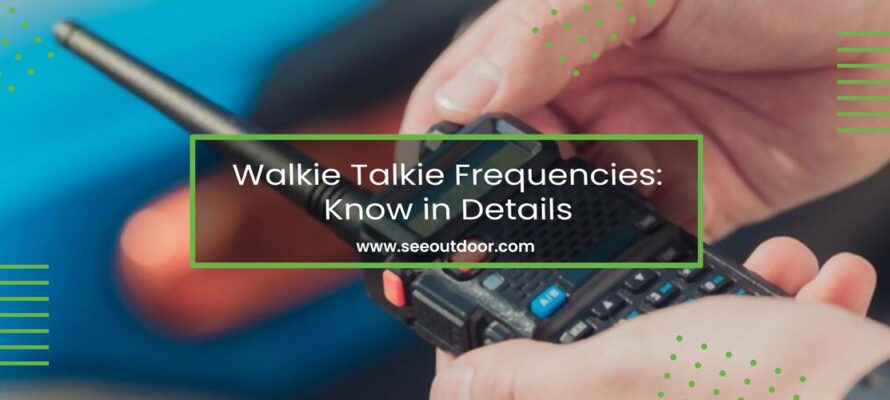
A walkie-talkie is a handheld gadget that allows two-way communication via radio signals and frequencies. For two-way radio communication, walkie-talkie frequencies fall into a specified range. The Federal Communications Commission has designated many radio bands for various applications. They include private, public, and commercial walkie-talkie uses.
Each type of walkie-talkie has its own set of rules and restrictions regarding channel frequencies. Some walkie-talkies require permits to use, while others do not. Most walkie-talkie frequency ranges from 136 to 900 MHz, but there are more to know in detail.
Complete Guide to Walkie-Talkie Frequencies
Radio devices can communicate via a variety of frequencies. So, let’s go through which walkie-talkie channel frequencies are now in use one by one.
Family Radio Service (FRS)
The first one on our list is the Family Radio Service (FRS). The FRS is a no-cost radio service with no licensing requirements up to a specific watt of power.
This frequency service is meant for personal, short-distance two-way communication and not business use. FRS employs channels in the 462–467 MHz ultra-high frequency (UHF) band.
There are a total of 22 channels in the FRS. But they follow the specific wattage level. To begin with, channels 1 to 7 can be a maximum of 2 watts, while channels 8 to 14 can be up to 0.5 watts. Finally, the remaining channels, 15 to 22, can reach up to 2 watts again.
FRS radios often have a range of half a mile to a few miles, based on the surroundings and obstructions in the way. Some FRS radios provide you access to GMRS-only channels that you shouldn’t use unless you have a GMRS permit.
On the channels above and within the specified power, FRS radio units can be used anywhere in the United States.
General Mobile Radio Service (GMRS)
Any radio with a power output of more than 2 watts is considered GMRS. A permit is required to utilize the General Mobile Radio Service (GMRS). The most common range of ultra-high frequency (UHF) bands for GMRS is from 462 to 467 MHz.
Although the FRS and GMRS use some of the same frequencies, a GMRS license allows you to use your radios at higher power on selected channels.
There are 22 channels in the GMRS. The first 7 channels, 1 to 7, have a power wattage level of up to 5 watts.
On the other hand, channels 8 to 14 have lower power levels to a maximum of 0.5 watts. Finally, the last channels, 15 to 22, can reach up to 50 watts in power.
GMRS also features eight repeater channels that can handle up to 50 watts of power. However, like FRS, you can only use 0.5 watts on channels 8-14.
There are some significant advantages to adopting GRMS instead of FRS. They can be used with repeaters and external antennas, and they can also run at higher wattages on certain channels. GMRS will be able to communicate over considerably longer distances than FRS because of these qualities.
The cost of GRMS licensing
To legally use GMRS frequencies, you’ll need a license. A GMRS license costs $70 and lasts ten years. The FCC has not yet determined when the price will drop to $35.
To obtain a GMRS license, there is no need to take a test; instead, you complete an online application and pay a fee.
You will be given an identification number when you receive your license, which you can share with your family members. It’s required to use it after a message or every 15 minutes throughout a long conversation to identify yourself.
Multi-Use Radio Service (MURS)
MURS is a radio service that is free to use up to a specific wattage and does not require licensing. It’s made for personal or business use over short distances. MURS broadcasts on channels between 151.82 and 154.60 MHz in the very high frequency (VHF) band.
It has a total of 5 channels.
The first channel, called Channel 1, has a VHF band of 151.82 MHz, with a maximum bandwidth of 11.25 kHz.
Channel 2 has a slightly higher VHF than channel 1, with the value being 151.88 MHz.
Subsequently, channel 3 VHF is again a bit higher than channel 2 VHF, with the maximum amount reaching up to 151.94 MHz. Both channel 2 and channel 3 have a maximum bandwidth level of 11.25 kHz.
Similarly, channels 4 and 5 have a maximum bandwidth of 20 kHz.
However, the channel 4 VHF band reaches up to 154.57 MHz, while the channel 5 VHF band is the highest at 154.60 MHz.
The power output of MURS units is limited to two watts. To minimize audio difficulties and disturbance with other channels, using the correct bandwidths when configuring radios is critical.
MURS does not allow repeaters, but you can extend your range with extra antennas.
The MURS channels are less extensively utilized and may have less traffic than FRS channels. This is a benefit of choosing MURS versus FRS.
Business Radio Service (BRS)
BRS, commonly known as the Industrial/Business Radio Pool Service (Business Band), is another licensed radio service. It comprises some of the following frequencies that have been set aside exclusively for corporate use: VHF, UHF, and GMRS are all low-band radio frequencies. In the business band, there is a long list of frequencies.
The cost of business radio licensing
A license is required for most corporate radios to verify that you are not using an unlicensed frequency. A single-frequency license costs $449 without a base station or repeater and $549 with one. The license is valid for ten years, and a business may expect to pay roughly $50 per year.
On the other hand, many firms prefer not to obtain a license, even though the fines for not doing so might be thousands of dollars if you are found. You must cooperate with an FCC band coordinator and fill out an online form to obtain a business license.
Extreme Radio Service (eXRS)
Extreme Radio Services (eXRS) is a free streaming service that does not require licensing but is associated with a single radio band. It operates on channels at approximately 900 MHz in the ultra-high frequency (UHF) band. To utilize eXRS, you’ll need a TriSquare radio, but the manufacturer is no longer in operation.
Frequency hopping technology distinguishes eXRS from other radio systems, making it more difficult for your conversations to be recorded. According to the business, their gadgets can safely sustain up to 100,000 people within range of one another.
The eXRS radios also can send SMS-like messages through digital radio modes. While the TriSquare brand is discontinued, you may still purchase their devices second-hand off eBay or Craigslist.
Very High Frequency (VHF)
The Very High Frequency (VHF) categorization covers wavelengths between 30 and 300 MHz. VHF waves are wider and can go farther with less power. VHF is a much better alternative for outdoor use when there are not many obstacles in the way.
Air traffic control and various maritime radio services are among the most common services that use the VHF frequency.
Ultra-High Frequency (UHF)
The Ultra-High Frequency (UHF) categorization applies to frequencies ranging from 300 MHz to 3 GHz.
Since the radio signals are narrower and may pass through impediments more readily, UHF is often preferred for indoor use.
This could also be a good option if you live in a mountainous area or have a lot of barriers to overcome, such as trees. The majority of walkie-talkies use the UHF band.
Finding the Best Walkie Talkie Frequency for You
Adjust the VHF or UHF on your smartphone to get the best walkie-talkie frequency. When conversing over long distances, VHF is the best option.
In contrast, UHF has higher bandwidth, which allows for more efficient communication, yet it is only suitable for short-range communication. VHF can be set between 130 and 174 MHz, while UHF can be set to the balanced pointer.
Conclusion
Walkie Talkies are two-way communication devices that are portable and lightweight. There are numerous advantages to walkie-talkies. And knowing all the walkie-talkie frequencies in detail can be vital for understanding their service ranges.
Even though the device has decreasing popularity, it is handier than most common communication devices. Our guide will assist you in determining which one will best fit your everyday requirements. Most walkie-talkies in the market support VHF and UHF frequencies.
FAQ
What frequency do walkie-talkies use?
The FCC defines two-way walkie-talkies as operating in the frequency range of 136 MHz to 900 MHz. For a complete list guide, you can refer to this guide article to know all about different specific frequencies.
What are two-way walkie-talkie frequencies?
A two-way walkie-talkie enables two people to converse using radio waves. You can send and receive signals with a two-way walkie-talkie.
Also, the operator can communicate with other users using the same walkie-talkie frequency. To communicate, the two devices must be on the same channel.
 CTCSS vs DCS: Know about Technologies Behind Walkie Talkie
 How Do Walkie Talkies Work?
 VHF vs UHF: Know the Differences